%3Aformat(webp)%2Fhubspot_blogs%2F10216657838-UvwjDmnLIiEUJxnxGGRXHGgFfF9TfDSxyEtAfJELmiXKoMsJWEHlRryuU5y07ZbeBX6c_zc5TOMJT34QOnmZkKWL_9psyOmmtpxc8FmaDH6WaEtUUIIyUSjiwTShqDoJgj_mQa.png&w=1920&q=75)
If this is your first trip to South America, take Peru on its own. If you have travelled long-haul before and want the Andes properly, take the trilogy.
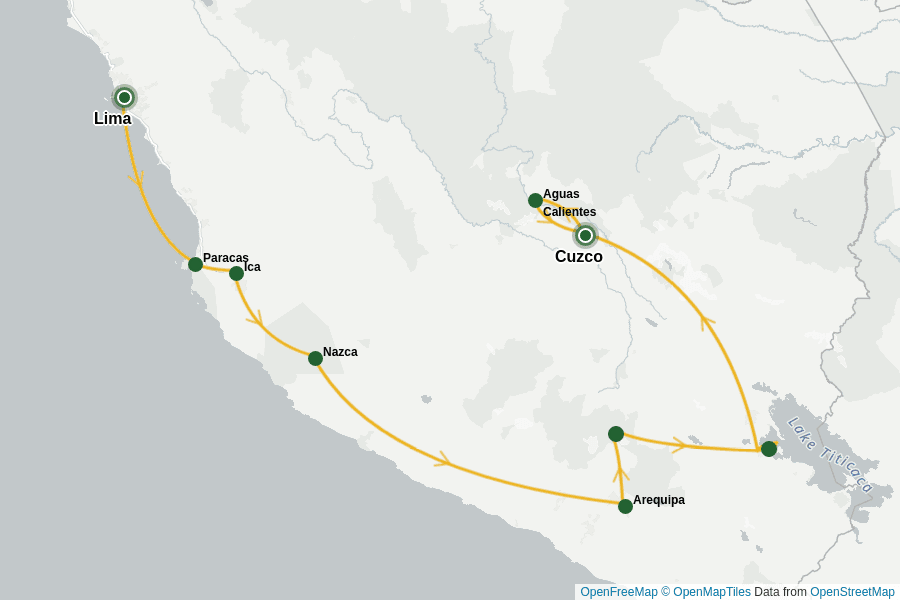
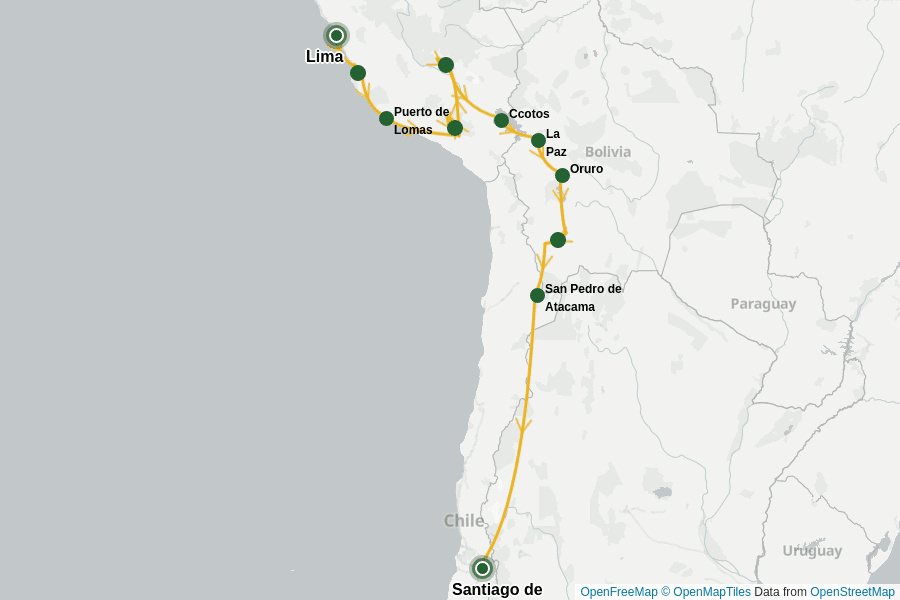
The two routes share their first act. Both give you Lima, Cusco, the Sacred Valley and Machu Picchu. The difference is what happens afterwards: sixteen days in Peru turns south to Lake Titicaca, the Colca Canyon, Arequipa and the desert coast, while the twenty-three-day Peru, Bolivia & Chile route crosses into the Bolivian altiplano and on to the Atacama.
In short
%3Aformat(webp)%2Fhubspot_blogs%2F7428715829-funnyalpacaswithawesomeamazinghilarioushair17.jpg&w=1920&q=75)
Not more of the same — somewhere entirely different.
After Lake Titicaca, the trilogy crosses into Bolivia and up onto the altiplano: a high, thin, enormous landscape of salt, lagoons and volcanoes. The Salar de Uyuni is the centrepiece, and it is genuinely unlike anywhere else on earth — a white plain that becomes a mirror when it holds water, with islands of cactus standing out of it.
Beyond it lies the Atacama in northern Chile, the driest desert in the world: red rock, geysers, salt lagoons and the clearest night skies most people will ever stand under.
Those two landscapes are the reason to take the longer route. If they do not move you when you read about them, the extra week is not for you — and Peru on its own is a superb trip that leaves nothing important out.
%3Aformat(webp)%2Fhubspot_blogs%2F146480866949-titicacalakepeople.png&w=1920&q=75)
Three things, and they compound.
Altitude, sustained. This is the important one. The Peru route touches high passes but sleeps lower. The trilogy lives on the altiplano for days at a time. If altitude concerns you at all, this is the wrong trip — see where to go in Latin America if altitude is a problem.
Distance and remoteness. Long drives across places with very little in them. That is the appeal, and it also means basic facilities in stretches, and fewer comforts than the Peruvian section.
Time. Twenty-three days is a serious block of leave. Add the flights and you are close to a month.
In exchange, the group is smaller — a maximum of 12 rather than 15 — which on a route like this matters.
%3Aformat(webp)%2Fimg%2F2048x1536%2F162721.jpg&w=1920&q=75)
Take Peru on its own if this is a first trip to South America, if you have a fortnight or so rather than a month, if altitude is any kind of question, or if you would like the Colca Canyon, Arequipa and the Nazca coast — all of which the trilogy leaves out.
Take the trilogy if you have done a long-haul small-group trip before and know how you travel, if Uyuni and the Atacama are the images in your head, and if three weeks is genuinely available to you.
A useful test: read the two itineraries and notice which one you are already planning in your head. In our experience travellers know, and then talk themselves out of it on grounds of practicality rather than desire.
And there is no wrong order. A good number of travellers do Peru first and come back for Bolivia and Chile later — our page on where to go after Peru covers the second-trip question.
%3Aformat(webp)%2Fimg%2F2048x1536%2F219032.jpg&w=1920&q=75)
Both routes reach Machu Picchu by train and bus — no trekking, no camping, hotels throughout. Both include an English-speaking Viventura guide for the whole trip plus local guides, all entrance fees, breakfast daily and the meals set out in the itinerary.
Both are land-only, so you choose the international flights that suit you; we publish recommended routes and timings. Note the trilogy is an open-jaw trip — in to Lima, home from Chile — so book a multi-city ticket.
Both run on guaranteed departures, so they go ahead regardless of how many others have booked.
If you are torn, tell a Latin America specialist how many days you can actually take and how you feel about altitude. Those two answers usually settle it within a minute.

Customer Satisfaction
Ventura Travel Brands' tours have been rated as excellent by travellers
%3Aformat(webp)%2Fe7209c14-91b8-45db-adf7-23e2e7465143-ventura-travel-icon.png&w=1920&q=75)
A trusted travel partner for over 2 decades
Over 100,000 people have travelled with Ventura Travel's brands since 2001

Sustainability Certification – TourCert
As a responsible Tour Operator, we are certified by TourCert
Select Date Range
%3Aformat(webp)%2Fuser%2F97e51b2b-9e9d-4832-b179-05a00540180b-matthew-jones.png&w=1920&q=75)
Matthew Jones
Sales Specialist UK Market
%3Aformat(webp)%2Fuser%2F354bd62e-8c8e-4fc6-92af-6b4b0bfc4a66-imagen_generada.png&w=1920&q=75)
Rosa Pacheco
Trip Specialist
%3Aformat(webp)%2Fday_detail%2F9d867558-f96f-4d35-a27d-a091dd43e6c5-paul-vhze9fd9mrs-unsplash.jpg&w=1920&q=75)
%3Aformat(webp)%2Fday_detail%2Fcc08b512-78f2-4278-97fd-481027441792-aarom-ore-yrqyn1gb80k-unsplash.jpg&w=1920&q=75)
%3Aformat(webp)%2Fheader_media%2Fe1ee5a5c-8a9e-4884-8dcf-fd82866a1552-header-xpbc.jpg&w=1920&q=75)
%3Aformat(webp)%2Fimg%2F2048x1536%2F162755.jpg&w=1920&q=75)