%3Aformat(webp)%2Fhubspot_blogs%2F10216657838-UvwjDmnLIiEUJxnxGGRXHGgFfF9TfDSxyEtAfJELmiXKoMsJWEHlRryuU5y07ZbeBX6c_zc5TOMJT34QOnmZkKWL_9psyOmmtpxc8FmaDH6WaEtUUIIyUSjiwTShqDoJgj_mQa.png&w=1920&q=75)
Bolivia is one of the most extraordinary and authentic countries in Latin America — but we'll be honest, because it matters: it's a bolder choice for a first long-haul trip than gentler destinations. The reason isn't safety or friendliness (Bolivia has plenty of both); it's the extreme altitude. You often arrive straight into over 4,000 m, higher than almost anywhere else you might travel, and that asks something of your body. Add a long journey (no direct flights) and Bolivia's slow, occasionally disrupted roads, and it rewards travellers who go in prepared.
That doesn't mean a first-timer shouldn't go — many do, and love it — but our honest advice is to approach it thoughtfully: ideally combine it with Peru (so you acclimatise gently before Bolivia's greater heights), travel with a good operator, and plan the altitude carefully. Do that, and Bolivia is a magnificent, rewarding adventure.
Below we explain who Bolivia suits as a first trip, the altitude and the journey, and how a guided, well-sequenced trip makes all the difference.
The quick answer
%3Aformat(webp)%2Fhubspot_blogs%2F146480866949-MancoCapacmonument.png&w=1920&q=75)
This is the honest heart of it. Bolivia is safe, welcoming and endlessly fascinating — the issue is purely the altitude, and how your body handles arriving high with little time to adjust. For a fit, curious traveller who plans sensibly, Bolivia can absolutely be a wonderful first big trip. For someone nervous about long-haul travel, or with any heart or lung concerns, the extreme altitude makes it a more challenging choice than most.
So it comes down to preparation and temperament. If the surreal Uyuni salt flats, the dramatic canyons of La Paz and the living indigenous cultures excite you more than the altitude worries you — and you're willing to plan carefully — go, with good support. If you'd rather build up gently, a slightly lower-altitude or easier first trip (Peru's classic route, Sri Lanka, South Africa) makes a wonderful introduction, with Bolivia as a superb next adventure. There's no wrong answer — only what suits you.
Bolivia's altitude is the single most important factor in whether it suits you as a first trip, so plan for it above all else:
We cover all of this in depth in our Bolivia altitude guide — but the headline for a first-timer is: the altitude is manageable with careful planning, and it's the thing to get right.
The journey. There are no direct flights from the UK to Bolivia, so you'll connect — commonly via Madrid, or via Lima or Santa Cruz — for a total of around sixteen to twenty hours. The connection is a chance to break the journey, and a stopover (in Lima or Madrid) can ease both the travel and the altitude transition. The jet lag is modest, at five to six hours behind the UK.
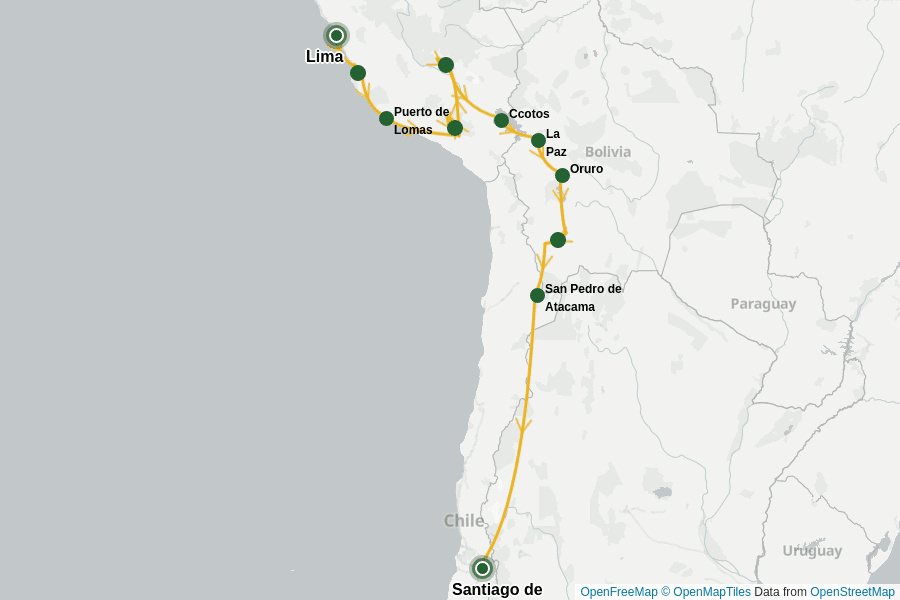
Pairing with Peru — our strong recommendation for first-timers. Because Peru's classic sights (Cusco, the Sacred Valley, Machu Picchu) sit slightly lower and are reached more gradually, a Peru-then-Bolivia trip lets you acclimatise gently before Bolivia's greater heights — and makes a magnificent combined Andean journey, sharing Lake Titicaca between the two. For a first-timer especially, this is far kinder than flying straight into La Paz, and it's how many of our Bolivia travellers do it.
%3Aformat(webp)%2Fheader_media%2F82b89548-fa6b-4a8c-b45b-7d4fba4d2a8a-199555.jpg&w=1920&q=75)
For a first Bolivia trip, a guided, carefully-sequenced journey isn't just nice to have — it's what makes the difference between struggling and thriving.
How our experience helps
We plan Bolivia around the altitude and the roads. We sequence itineraries to acclimatise you gradually — often starting in Peru or at lower Sucre before La Paz and Uyuni — keep the crucial first days gentle, and pace the demanding, remote Uyuni tour sensibly. Our team handles the transport with experienced local drivers, monitors Bolivia's roadblocks and reroutes around them, and chooses comfortable hotels as restful bases at altitude. Our guides carry the local knowledge that counts for so much here, and bring Bolivia's cultures and landscapes to life. There's always someone to turn to if the altitude affects you. For a great many of our travellers, this careful support turned Bolivia — a country they'd been unsure they could manage — into one of the most extraordinary trips of their lives.
Frequently asked questions
Is Bolivia a good first long-haul destination for older travellers? It's extraordinary but demanding, chiefly because of the extreme altitude. For the well-prepared and curious it can be wonderful, especially paired with Peru; for the nervous, a gentler destination first, with Bolivia as a second trip, is a good choice.
Why is Bolivia harder than some first trips? The altitude — you often arrive at over 4,000 m with no gradual ascent, higher than almost anywhere. It's very manageable with careful planning, but it's the real consideration.
How bad is the jet lag from the UK to Bolivia? Modest — Bolivia is about five to six hours behind the UK. The bigger adjustment is the altitude, not the time zone.
Should I combine Bolivia with Peru? Yes, especially as a first-timer — starting in Peru's slightly lower sights helps you acclimatise before Bolivia's greater heights, and makes a magnificent combined trip. It's our strong recommendation.
Are there direct flights to Bolivia? No — you connect via Madrid, Lima or Santa Cruz, for a total of around sixteen to twenty hours. A stopover can ease both the journey and the altitude transition.
Can I go to Bolivia with a heart condition? Given the extreme altitude, this is exactly the case to discuss with your GP before booking. For many it's achievable with a careful plan; for some, the highest spots may warrant caution or alternatives.
Related reading
Contact us
We’d love to hear from you. Please fill out this form.
All fields marked with (*) are mandatory.
%3Aformat(webp)%2F02e7f2c3-d3bc-4247-8176-ffa581b64506-vi_ventura_logo_1402px_full_color.png&w=1920&q=75)
%3Aformat(webp)%2Fprofile-picture%2F5fd79a46-6a23-4547-8518-b4068b58975f-f3895e68-219c-4e67-87c6-d80f42d2c815-9D14F6FB-5601-48CA-8E3C-B9B459218497.jpg&w=1920&q=75)
%3Aformat(webp)%2Fprofile-picture%2F16d4fa55-a01d-4c4d-89a0-c0ef30433177-b00f6910-f87f-437d-a370-84b636b084b9-7a1c726f-d235-472c-b4e0-c7553c729b9e.jpeg&w=1920&q=75)
%3Aformat(webp)%2Fprofile-picture%2Ff1b036fb-3cc5-4b59-beb3-f41c82e58932-52bd8473-9a08-49b8-9025-b47e6b62b14c-F427B006-14B0-4847-85AB-D370D8EB1197.jpg&w=1920&q=75)
%3Aformat(webp)%2Fprofile-picture%2F1b94eff9-5e96-4b30-803e-8093ce7b42ef-1630fbda-e666-49b7-9a9e-5ac18b0d1926-2C56EE68-21D4-4E67-BD45-6A6D4199A045.jpg&w=1920&q=75)
%3Aformat(webp)%2Fheader_media%2Fe1ee5a5c-8a9e-4884-8dcf-fd82866a1552-header-xpbc.jpg&w=1920&q=75)
%3Aformat(webp)%2Fimg%2F2048x1536%2F162755.jpg&w=1920&q=75)