%3Aformat(webp)%2Fhubspot_blogs%2F10216657838-UvwjDmnLIiEUJxnxGGRXHGgFfF9TfDSxyEtAfJELmiXKoMsJWEHlRryuU5y07ZbeBX6c_zc5TOMJT34QOnmZkKWL_9psyOmmtpxc8FmaDH6WaEtUUIIyUSjiwTShqDoJgj_mQa.png&w=1920&q=75)
For Bolivia's classic highland highlights — La Paz, Lake Titicaca, the Uyuni salt flats and perhaps colonial Sucre — you want around eight to twelve days. That allows time to acclimatise gently to the extreme altitude (essential here), to reach the remote Uyuni salt flats at a sensible pace, and to enjoy the country without rushing. A week is possible but tight given the altitude; two weeks lets you add the Amazon or more of the south.
Bolivia is also very often combined with Peru — the two share Lake Titicaca, and a Peru-and-Bolivia trip of two to three weeks is a classic, letting you acclimatise in Peru's slightly lower Sacred Valley before Bolivia's greater heights. Because of the altitude and Bolivia's slow, sometimes unpredictable roads, pacing matters more here than almost anywhere.
Below we break down how long each place needs, what fits into a week or two, how to pace things over 50, and how Bolivia combines with its neighbours.
The quick answer
%3Aformat(webp)%2Fhubspot_blogs%2F146480866949-MancoCapacmonument.png&w=1920&q=75)
Bolivia's classic circuit is built from a few high-altitude blocks:
Most trips combine La Paz, Titicaca and Uyuni, often with Sucre, which is why eight to twelve days works well.
About a week (7–8 days): the core highlights — La Paz, Lake Titicaca and the Uyuni salt flats. It's a wonderful introduction, but tight given the altitude, so you must build in gentle first days and not overreach. Good if time is limited, provided you respect the acclimatisation.
Ten to twelve days: the comfortable version — the same highlights plus Sucre (lower and restful) and perhaps Potosí, at a pace that respects the altitude and Bolivia's slow roads. For many over-50s this is the ideal Bolivia trip.
Two to three weeks: Bolivia combined with Peru — the classic pairing — letting you acclimatise gently in Peru's Sacred Valley and Cusco before Bolivia's greater heights, taking in Machu Picchu, Titicaca (from both sides) and Uyuni. Or add the Amazon for contrast. This is the richest way to experience Bolivia.
Given the altitude and the roads, resist cramming too much in — Bolivia rewards a measured pace far more than a dash.
Pace for comfort — and altitude. In Bolivia, pacing isn't just about comfort; it's about health at extreme altitude:
Combining with Peru. Because the two countries share Lake Titicaca and Peru's classic sights sit slightly lower, a Peru-then-Bolivia trip is not only a wonderful journey but a sensible way to acclimatise — you build up through Cusco and the Sacred Valley before tackling La Paz and Uyuni. Many of our Bolivia travellers do exactly this.
A common mistake is underestimating the altitude and the roads and packing in too much — the surest way to feel unwell or frazzled. A measured pace transforms the trip.
%3Aformat(webp)%2Fheader_media%2F82b89548-fa6b-4a8c-b45b-7d4fba4d2a8a-199555.jpg&w=1920&q=75)
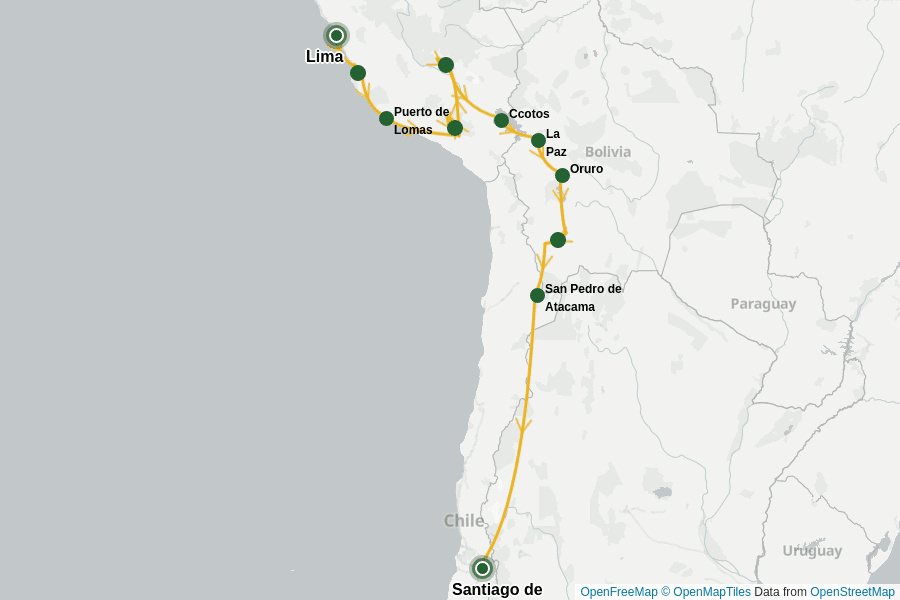
With more time, Bolivia offers striking contrasts: the Amazon rainforest and pampas around Madidi (a hot, low-altitude change of scene and superb wildlife), the southern deserts and lagoons beyond Uyuni towards Chile's Atacama, the Jesuit Missions of the eastern lowlands, or a deeper combination with Peru or Chile for a grand Andean journey.
How our experience helps
We plan Bolivia trips around the two things that matter most here: the altitude and the roads. We sequence itineraries to acclimatise gently — often starting lower or building up through Peru — keep the crucial early days easy, allow flexibility for Bolivia's slow and sometimes disrupted roads, and pace the demanding Uyuni tour sensibly. We link it seamlessly with Peru when you'd like the classic combined trip. Our local knowledge is invaluable in a country where timing and flexibility count for so much. We'd rather you experienced La Paz, Titicaca and Uyuni comfortably than raced them at 4,000 m — and travellers consistently tell us the measured pace was what made it.
Frequently asked questions
Is a week enough for Bolivia? It covers the core — La Paz, Lake Titicaca and Uyuni — but it's tight given the altitude, which you shouldn't rush. Ten to twelve days is more comfortable, adding gentler, lower Sucre.
How many days do I need for the Uyuni salt flats? Often a three-day 4x4 tour, taking in the flats, coloured lagoons and high-altitude deserts. Even a shorter visit needs a couple of days, and it's best done once you've acclimatised.
Should I combine Bolivia with Peru? It's a classic and highly recommended pairing — the two share Lake Titicaca, and starting in Peru's slightly lower sights helps you acclimatise before Bolivia's greater heights. Allow two to three weeks.
How do you get around Bolivia? By road (with experienced local drivers) and short domestic flights, with 4x4s for the Uyuni region. Roads are slow and can be disrupted, so flexibility matters. On a guided trip it's all arranged.
Is two weeks too long in Bolivia? Not if you combine it with Peru or add the Amazon — two to three weeks makes a rich Andean journey. For Bolivia's highlands alone, eight to twelve days is often ideal.
Why does pacing matter so much in Bolivia? Because of the extreme altitude and the slow, sometimes disrupted roads. A measured, well-sequenced itinerary keeps you healthy and relaxed, rather than unwell or rushed.
Related reading
Contact us
We’d love to hear from you. Please fill out this form.
All fields marked with (*) are mandatory.
%3Aformat(webp)%2F02e7f2c3-d3bc-4247-8176-ffa581b64506-vi_ventura_logo_1402px_full_color.png&w=1920&q=75)
%3Aformat(webp)%2Fprofile-picture%2F5fd79a46-6a23-4547-8518-b4068b58975f-f3895e68-219c-4e67-87c6-d80f42d2c815-9D14F6FB-5601-48CA-8E3C-B9B459218497.jpg&w=1920&q=75)
%3Aformat(webp)%2Fprofile-picture%2F16d4fa55-a01d-4c4d-89a0-c0ef30433177-b00f6910-f87f-437d-a370-84b636b084b9-7a1c726f-d235-472c-b4e0-c7553c729b9e.jpeg&w=1920&q=75)
%3Aformat(webp)%2Fprofile-picture%2Ff1b036fb-3cc5-4b59-beb3-f41c82e58932-52bd8473-9a08-49b8-9025-b47e6b62b14c-F427B006-14B0-4847-85AB-D370D8EB1197.jpg&w=1920&q=75)
%3Aformat(webp)%2Fprofile-picture%2F1b94eff9-5e96-4b30-803e-8093ce7b42ef-1630fbda-e666-49b7-9a9e-5ac18b0d1926-2C56EE68-21D4-4E67-BD45-6A6D4199A045.jpg&w=1920&q=75)
%3Aformat(webp)%2Fheader_media%2Fe1ee5a5c-8a9e-4884-8dcf-fd82866a1552-header-xpbc.jpg&w=1920&q=75)
%3Aformat(webp)%2Fimg%2F2048x1536%2F162755.jpg&w=1920&q=75)