%3Aformat(webp)%2Fcountry%2F8b4aab1a-545f-4b7e-b6fa-985ddbd38ce7-saqsaywuama.jpeg&w=1920&q=75)
Two weeks is enough for Peru — but only if you choose a route rather than a wish list. In a fortnight you can comfortably combine Lima, Cuzco and the Sacred Valley, Machu Picchu and Lake Titicaca. Add the Colca Canyon, Arequipa and the desert coast and you are into a sixteen-day trip, which is exactly why ours runs to sixteen days rather than fourteen.
The temptation with Peru is to keep adding. The country rewards the opposite instinct. Distances are long, several highlights sit above 3,000 metres, and a day lost to an internal flight is a day not spent anywhere.
In short
%3Aformat(webp)%2Fhubspot_blogs%2F7428715829-funnyalpacaswithawesomeamazinghilarioushair17.jpg&w=1920&q=75)
A sensible two-week Peru trip has three anchors and one decision.
The anchors are Lima, where almost every long-haul flight lands and where a first gentle day at sea level is worth having; Cuzco and the Sacred Valley, which need four or five days between them if Machu Picchu is not to feel like a smash-and-grab; and Machu Picchu itself, reached by train and best entered early in the morning.
The decision is what comes fourth. Lake Titicaca is the usual answer — the Andean train from Cuzco is one of the great rail journeys, and the Uros reed islands are unlike anywhere else. The alternative is to turn south towards the Colca Canyon and Arequipa for condors and colonial streets.
Our route does not force that choice, which is the honest reason it needs sixteen days rather than fourteen.
%3Aformat(webp)%2Fhubspot_blogs%2F146480866949-titicacalakepeople.png&w=1920&q=75)
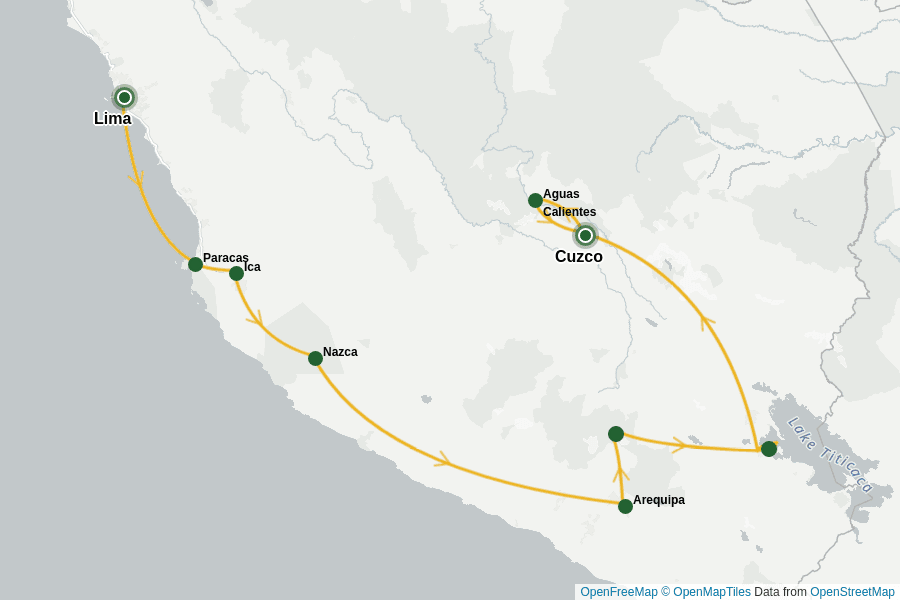
Days 1–2 — Lima. Arrival, and a first day at sea level exploring the City of Kings before any altitude is involved.
Days 3–5 — Cuzco. Fly up to 3,400 m and take it slowly. Two full days in the old Inca capital, its ruins and its markets.
Day 6 — Sacred Valley. Chinchero's weavers, the salt terraces of Maras, the agricultural terraces of Moray, then Ollantaytambo and the evening train down to Aguas Calientes.
Day 7 — Machu Picchu. An early bus up the switchbacks, a guided walk through the citadel, then trains back along the Sacred Valley.
Day 8 — the Andean train. A full day crossing the altiplano to Lake Titicaca, over the La Raya pass at 4,323 m.
Days 9–10 — Titicaca. The Uros reed islands, then on towards condor country.
Days 11–12 — Colca Canyon and Arequipa. One of the world's deepest canyons, the Patapampa pass at 4,910 m, then down to Arequipa's white volcanic streets at a much kinder 2,300 m.
Days 13–15 — the desert coast. The Nazca Lines, the Paracas National Reserve, the Ballestas Islands and the Huacachina oasis.
Day 16 — home.
%3Aformat(webp)%2Fimg%2F2048x1536%2F162721.jpg&w=1920&q=75)
Three, in our experience, and all of them avoidable.
Flying straight to Cuzco on day one. It is possible, and it is the single most common reason a trip starts badly. Arriving at 3,400 m after a long-haul flight, with no rest, is asking a great deal of your body. Starting in Lima costs a day and repays it several times over.
Booking Machu Picchu as an afterthought. Entrance tickets are capped and the early-morning slots on the classic route go first. This is one of the few places in travel where booking months ahead genuinely changes the experience rather than just the price.
Adding the Amazon. It is a wonderful thing to do and it does not fit into a fortnight that already contains the Andes. Give it its own trip, or accept that something else has to go.
We have written more about how many days you need in Peru if you are still weighing the length.
%3Aformat(webp)%2Fimg%2F2048x1536%2F219032.jpg&w=1920&q=75)
Peru: Treasures of the Andes runs sixteen days on the route above, with a maximum of 15 travellers. There is no trekking and no camping — Machu Picchu is reached by train and bus, and every night is spent in a hotel.
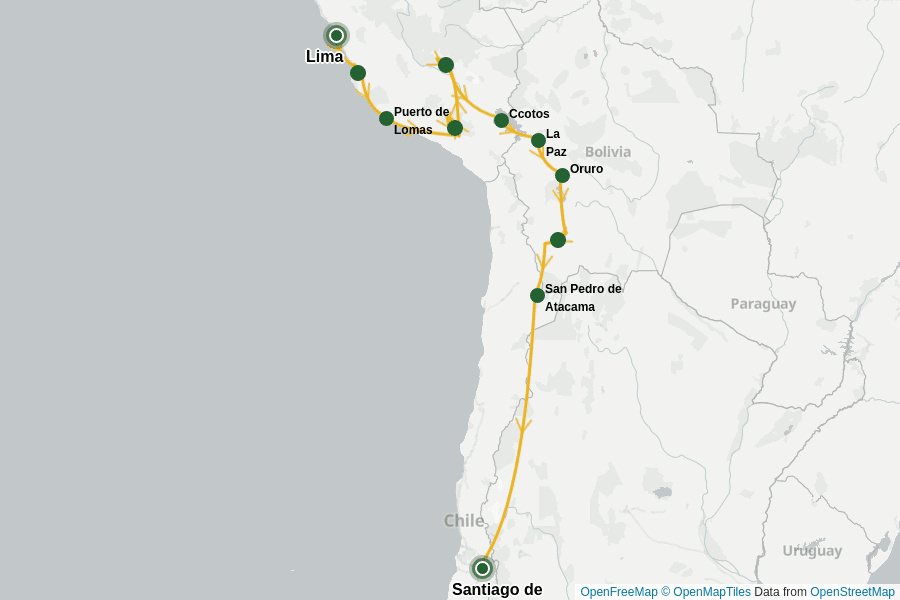
If you would like to keep going, Peru, Bolivia & Chile: Andean Trilogy carries the same Peruvian highlights onward across the altiplano into Bolivia and Chile, with a maximum of 12 travellers.
Both are land-only, so you choose the international flights that suit you; we publish recommended routes and timings for each. Both run on guaranteed departures.
If you are weighing a fortnight against something longer, a ten-minute conversation with one of our Peru specialists will settle it faster than another evening of reading.

Customer Satisfaction
Ventura Travel Brands' tours have been rated as excellent by travellers
%3Aformat(webp)%2Fe7209c14-91b8-45db-adf7-23e2e7465143-ventura-travel-icon.png&w=1920&q=75)
A trusted travel partner for over 2 decades
Over 100,000 people have travelled with Ventura Travel's brands since 2001

Sustainability Certification – TourCert
As a responsible Tour Operator, we are certified by TourCert
%3Aformat(webp)%2Fuser%2F97e51b2b-9e9d-4832-b179-05a00540180b-matthew-jones.png&w=1920&q=75)
Matthew Jones
Sales Specialist UK Market
%3Aformat(webp)%2Fuser%2F354bd62e-8c8e-4fc6-92af-6b4b0bfc4a66-imagen_generada.png&w=1920&q=75)
Rosa Pacheco
Trip Specialist
%3Aformat(webp)%2Fday_detail%2F9d867558-f96f-4d35-a27d-a091dd43e6c5-paul-vhze9fd9mrs-unsplash.jpg&w=1920&q=75)
%3Aformat(webp)%2Fday_detail%2Fcc08b512-78f2-4278-97fd-481027441792-aarom-ore-yrqyn1gb80k-unsplash.jpg&w=1920&q=75)
%3Aformat(webp)%2Fheader_media%2Fe1ee5a5c-8a9e-4884-8dcf-fd82866a1552-header-xpbc.jpg&w=1920&q=75)
%3Aformat(webp)%2Fimg%2F2048x1536%2F162755.jpg&w=1920&q=75)